

Recently completed improvements to the Columbia Pike thoroughfare ensure residents and travelers in Arlington, VA, have a complete street that balances the needs and safety of all modes of travel while supporting high-quality, high-frequency transit service.
Since June 2022, RK&K has provided the full spectrum of construction management services to support Arlington County through the preconstruction, construction, and close-out phases of this $66 million, multi-phased corridor improvement project.
[JPG, 455.84 KB]
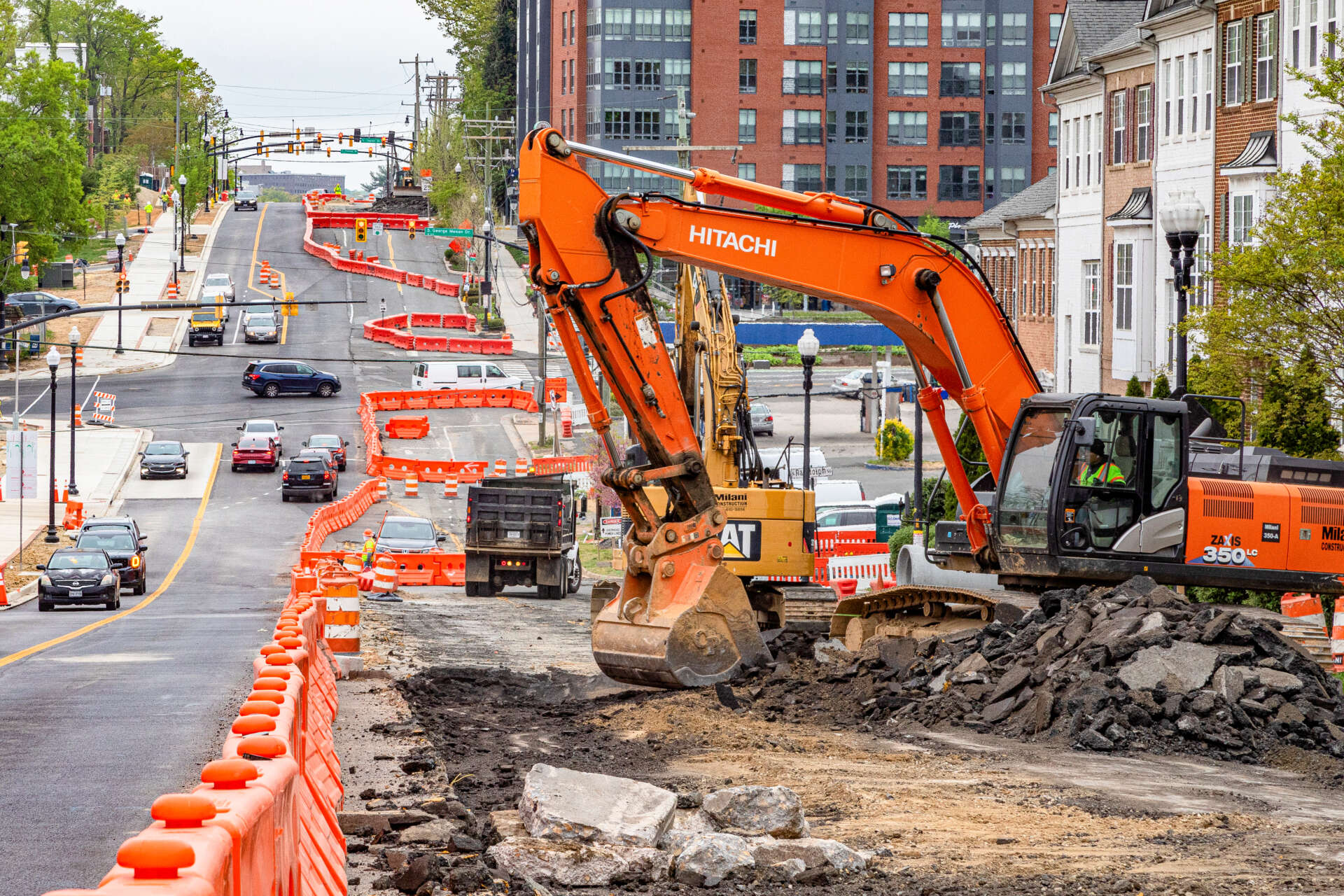
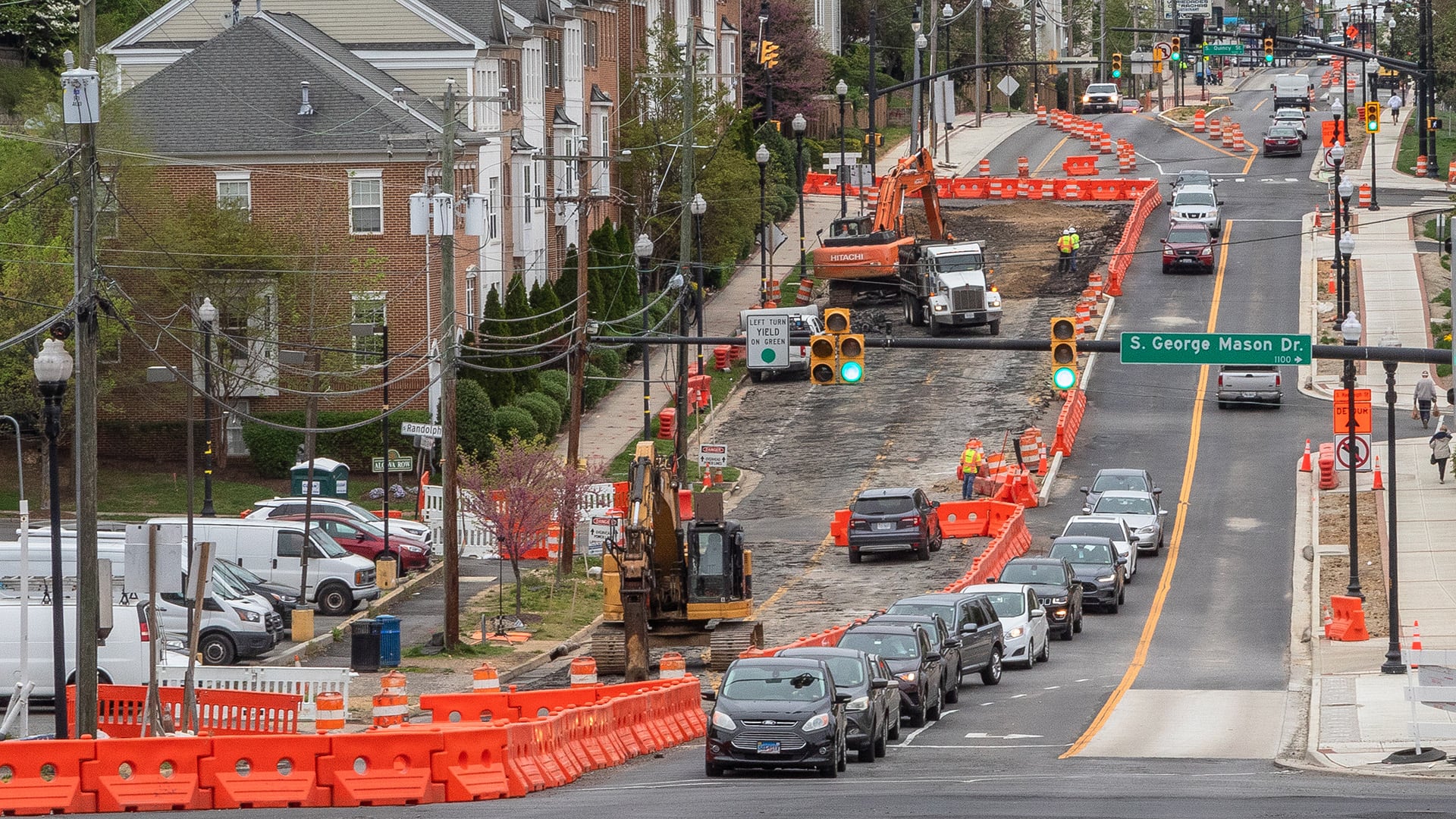
Residential views of Segment F combined MOT phases westbound lane.“Project construction was four years in the making. RK&K was proud to be a part of such an extensive and complex project,” said Director Chris Simon. “It was a steady stream of constant field changes, unknown utilities and revisions. There was a total of 174 plan revisions in which our managers and engineers organized daily and provided instant data to our field inspection staff. During many instances, RK&K inspection staff alternated with a night and day shift to accommodate utility outages for Arlington County and the contractor.”
The work included extensive maintenance of traffic, pedestrian detours, complete roadway restoration, retaining walls, undergrounding of electrical, communication and fiber lines, new storm drainage, waterline and sanitary sewer infrastructure, as well as other corridor improvements. Safety improvements included wider sidewalks for pedestrians and bicyclists, new signalized intersections and streetscape enhancements.
[JPG, 463.10 KB]
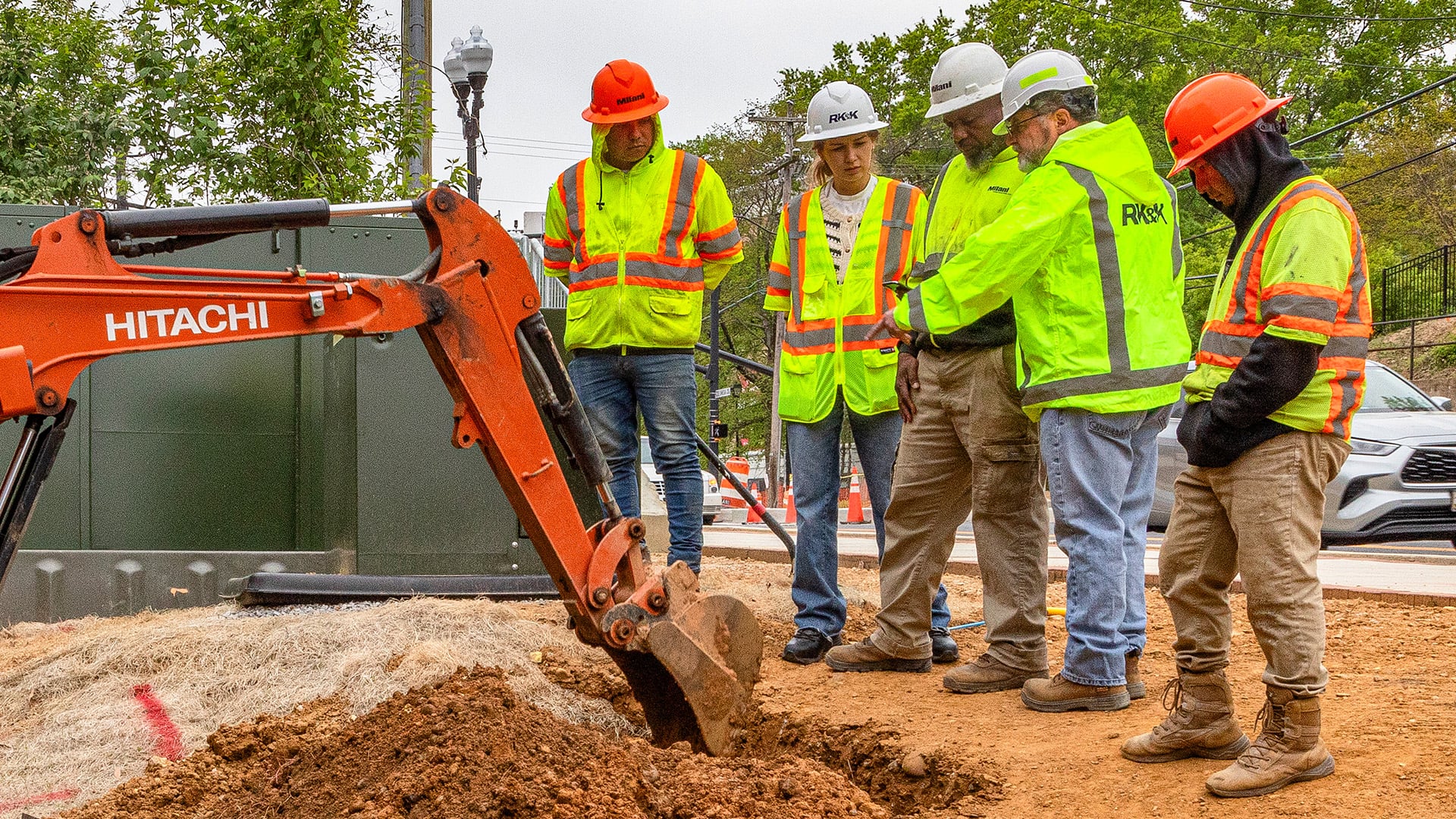
Construction Manager Gene McGillin overseeing underground utility conflict resolution.RK&K provided two full-time construction managers and two full-time office engineers. Their responsibilities included constructability reviews, CPM schedule reviews, conducting progress meetings, utility coordination, determining change order entitlement, negotiating change orders (334 total), coordinating submittal and RFI reviews (463 total), inspecting construction activities for conformance with contract drawings and specifications, tracking pay quantities, processing monthly payments and managing project closeout documentation.
To deliver this work successfully, our project team worked hand in hand with Arlington County’s in-house design team, Kimley Horn, and the Designers of Record, RDA Associates, to help the County deliver the project on time and within budget.
[JPG, 359.09 KB]
The contractor finishing reinforcement placement for the concrete deckOur construction managers, office engineers and field inspection staff provided critical field data to the design teams to help facilitate design decisions and troubleshoot issues as they arose.
Throughout the project, this close collaboration with the County was used to continually assess the level of support needed to keep construction moving efficiently and successfully. As the contractor’s workload evolved, RK&K adjusted staffing levels to meet the demands of the project. The team also collaborated with the County to refine work schedules, ultimately developing an alternative schedule that reduced overtime while keeping the project on track and within budget.
Behind the scenes, RK&K’s construction managers provided the oversight and coordination needed to keep every aspect of the project moving forward. They reviewed daily records for compliance, certified project documentation and ensured construction operations adhered to Occupational Safety and Health Administration (OSHA), Virginia Occupational Safety and Health (VOSH), Manual on Uniform Traffic Control Devices (MUTCD) and Virginia Work Area Protection Manual requirements. They also verified that field work met project specifications, managed change orders, monitored testing frequencies and requirements, administered project activities through eBuilder and provided on-site technical training to inspection staff. Throughout construction, they kept a close eye on CEI and project budgets while fostering open communication among the County, contractor and project team.
[JPG, 435.75 KB]
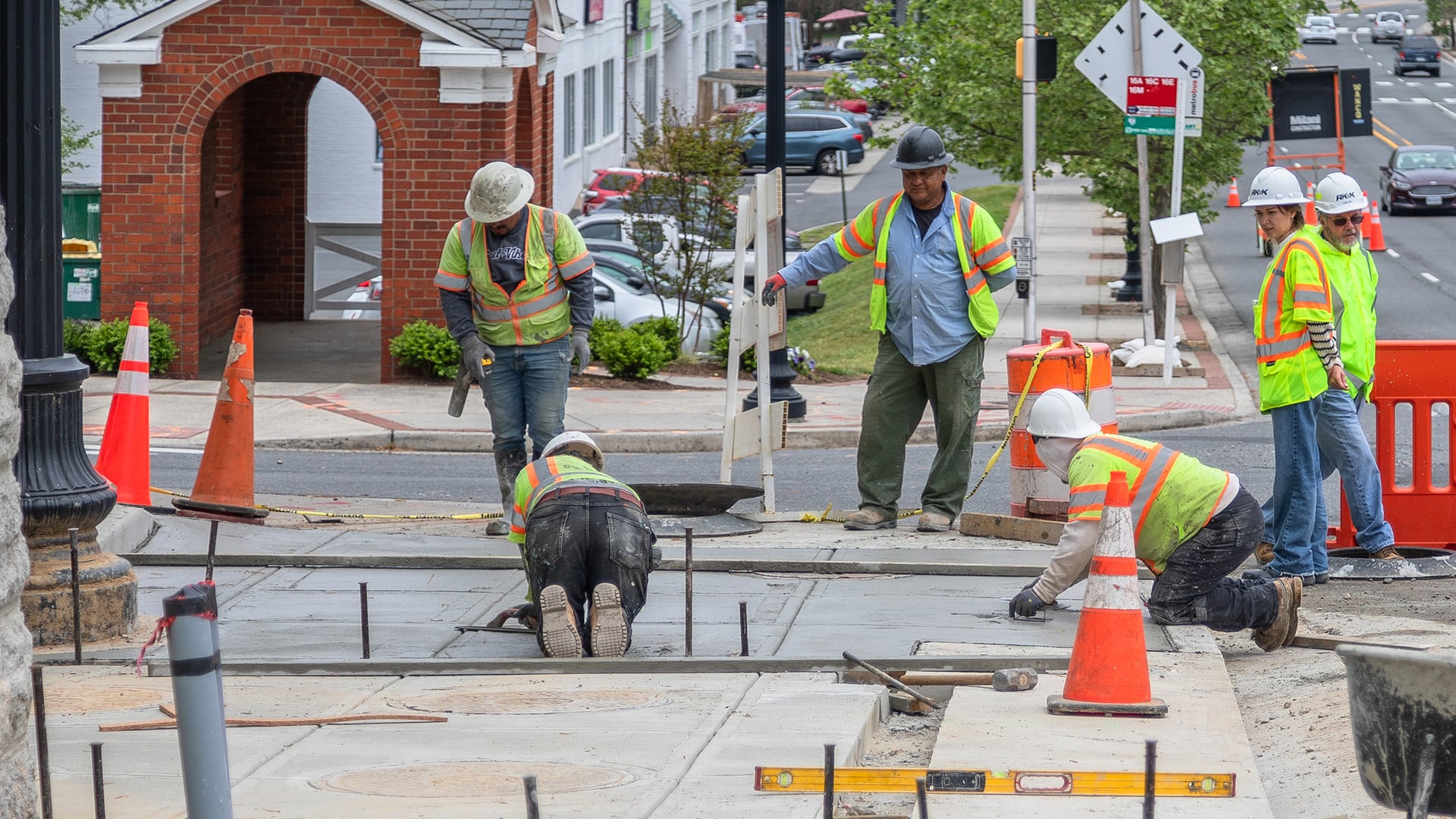
Crews installing concrete sidewalk and handicap ramps.In the field, our inspection staff served as an essential link between the plans and the work taking place on site. Inspectors monitored construction activities to ensure they followed the contract, plans and specifications while overseeing the contractor’s QC materials testing to confirm the project met established design and quality standards. They also monitored contractor safety practices, identified instances of non-compliance and worked with the contractor to develop solutions.
Due to the complexity of the project in an urban environment, inspection staff and managers were on a constant lookout for the safety of crews, the traveling public and pedestrians.
“The biggest challenge by far was to maintain safe routes proper signage and detours for the pedestrians. The urban setting of Columbia Pike — dense high-rise residential and commercial frontage with constant, heavy pedestrian activity — made safety the team’s top daily priority,” said Chris.
Their responsibilities extended beyond daily construction oversight. Inspectors helped track the project budget, monitored erosion and sediment control measures to ensure compliance and proper maintenance, and maintained comprehensive project records, including daily diaries, materials notebooks and other applicable project files. Together, these efforts provided the County with the hands-on oversight, flexibility and technical expertise needed to successfully deliver the project.
Inspection staff utilized eBuilder for all field documentation. In collaboration with Arlington County, RK&K staff worked with the Arlington County IT Department to tailor construction forms within the eBuilder system. This helped streamline documentation and organize project files for ease of use, explained Chris.
One of the most significant obstacles the team faced was the constant discovery of unknown utilities throughout the corridor. Again, they had to work together with the owner, designer and contractor to keep the project moving and minimize impacts to the project schedule and budget. Test pitting, including horizontal and vertical verification of existing utilities, was of particular importance to the design team.
With the addition of constant field changes, RK&K worked with the County to develop a strategy to increase inspection and management staff to ensure proper documentation while keeping CEI budget increases to a minimum.
Segment C created challenges early in the project with revisions and unknown utility issues. This resulted in the segment being pushed out in the overall schedule.
“Later in the project schedule, there was a big push from the owner an incentive was issued to the contractor to accelerate segment C. RK&K stepped up and met these demands with the owner to provide additional inspection staff and at times provide day and night inspection for utility outages.
[JPG, 491.90 KB]
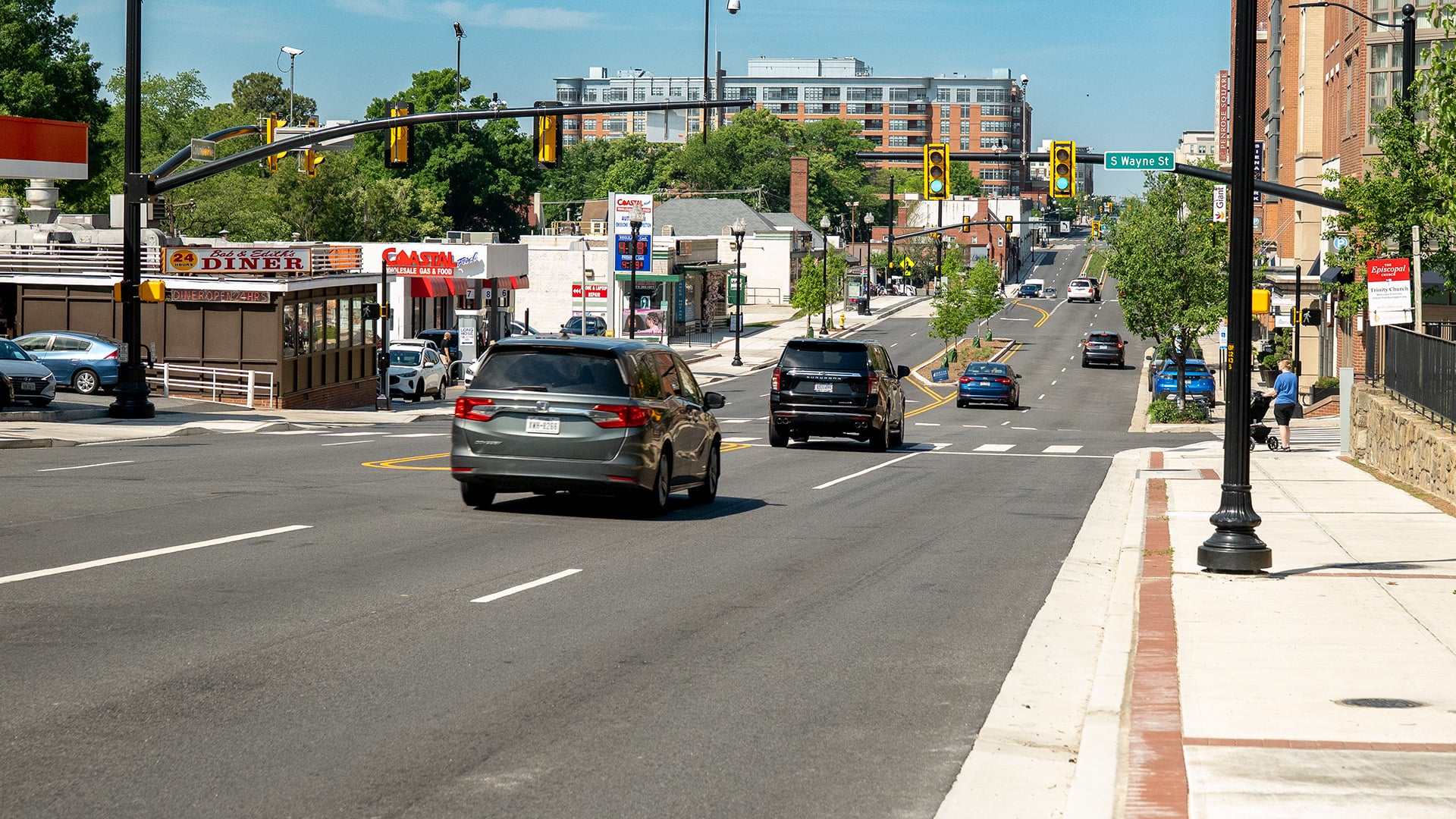
View of Segment D’s westbound lane commercial area.However, it was on Segment F that our team demonstrated that effective project management is about anticipating issues rather than just responding to them. Through careful planning, close collaboration with the County and contractor, and a deep understanding of the design and construction process we had cultivated over the year, our team identified potential challenges early and helped resolve them before they could affect the project’s schedule, budget or outcome.
The Segment F section of Columbia Pike was broken down into eight phases of Maintenance of Traffic. Our Construction Management team was able to reduce the eight phases to four phases in collaboration with the owner and the contractor, which ultimately helped lead to the early completion of this segment.
That same proactive approach extended to cost management. RK&K provided full Construction Management, Inspection Services and Project Controls for each segment along the entire corridor. The total RK&K budget for the entire corridor was $8,492,836.62.
The RK&K budgets for each segment were:
- Segment F: $3,299,149.18
- Segment A: $1,382,483.97
- Segment D: $2,412,101.70
- Segment C: $1,399,101.77
Through diligent management of resources and expenses, RK&K was able to save the County approximately $1.3 million over the course of the project. This demonstrated our ability to be a good steward of the County’s finances and strategically manage resources while maintaining the level of service needed to successfully bring the project to completion.
In addition, this technical expertise and attention to detail proved especially valuable during our review of the contract documents and ongoing construction activities. Our team consistently looked beyond the plans to identify potential conflicts, gaps and constructability concerns and worked with the County and Engineer of Record to address them before they became costly or time-consuming problems.
Here’s how we did it:
- Coordination: RK&K field engineers provided weekly visual exhibits to the owner for presentations at weekly progress meetings, showing work completed, ongoing work and remaining work.
- Closing design gaps: Early in the project, locations for proposed Dominion manholes and existing overhead electrical created a constructability issue with placement. This was identified by RK&K management and addressed with the designer. Other Dominion manholes in conflict with existing waterlines were identified early, revised and provided to the contractor prior to the start of activity. Since these revisions were made ahead of the proposed work, no delay occurred.
- Revisions to plans: Bus transit plans did not match the proposed electrical and communication drawings. Our management team caught this early in the project, allowing time to redesign underground services before contractors began work in this area.
- Addressing constructability issues: Our managers and office engineers provided detailed sketches and suggestions to the owner’s design team to keep the project moving forward.
This combination of technical expertise, proactive problem-solving and disciplined cost management allowed RK&K to give the County something equally important: confidence that potential issues were being addressed before they became problems, resources were being used efficiently, and the project remained positioned for successful delivery.
Work on the Columbia Pike Multi-Modal Street Improvements project was substantially completed in December 2025, meaning that sidewalks and vehicle lanes are officially open for travel.
Soon after, the success of this project was recognized with an Honorable Mention in the Transportation category by the Construction Management Association of America (CMAA). RK&K’s key team members were proud to accept the award and see their work recognized.
“After four years of planning, coordination, problem-solving, and dedication in the field, our team takes tremendous pride in what has been accomplished along the Columbia Pike corridor. This project stands as a lasting testament to RK&K’s collaboration, perseverance, fiscal stewardship, and technical expertise,” said Chris. “Through complex construction challenges, evolving conditions, and continuous stakeholder coordination, our team remained committed to a singular objective: delivering the best possible outcome for Arlington County and its residents. I am exceptionally proud of our team’s contributions in helping Arlington County create a safer, more connected, and more resilient corridor that will serve and benefit the community for generations to come.”
You might also be interested in:
Blog

Value Engineering: A Strategic Advantage in Modern Infrastructure Delivery